Insights / Iraq · Eridu
Chevron Is Getting West Qurna-2. Iraq's Biggest Discovery in 20 Years Is Not in the Deal.
Eridu holds 12.9 billion barrels, yet it is not in the Chevron deal. The binding constraint has moved from the reservoir to execution, counterparty, fiscal terms and export.
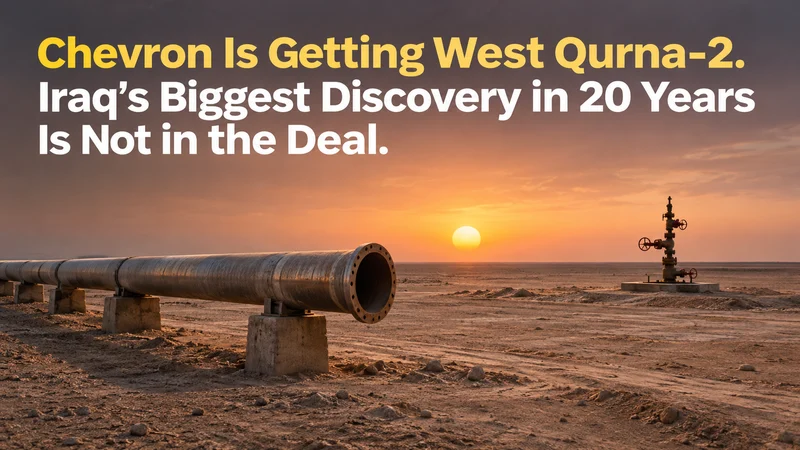
Iraq's oil minister says the West Qurna-2 contract with Chevron should be signed before year-end. Chevron's Joe Cook spoke of a long-term partnership on West Qurna-2 and Nasiriyah.
One name is missing: Eridu. 12.9 billion barrels, declared commercial in 2023, held by the same sanctioned seller. A year ago, an oil ministry source told MEES that Eridu was a key element of Chevron's pitch (paywall).
This is not a story about geology. It is a story about what a buyer actually pays for.
Two assets, one seller, two very different prices
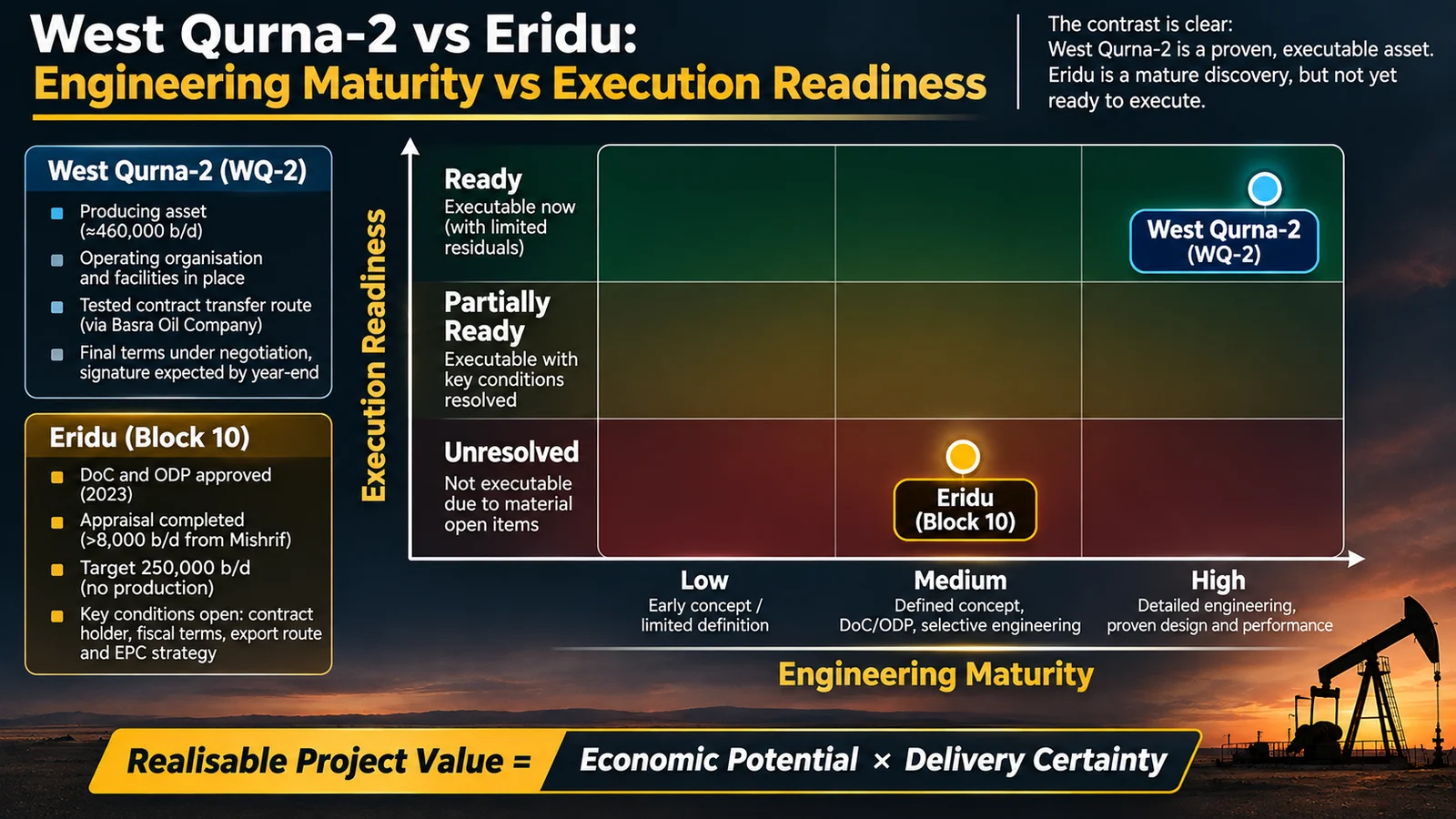
West Qurna-2 produces about 460,000 b/d. It has an operating organisation, cash flow and facilities with a known performance history. The transfer route is tested: the contract moves temporarily to Basra Oil Company, which then assigns it to Chevron once new terms are agreed.
Even so, Chevron reportedly pushed Iraq to improve the project's returns as a condition of entry.
Eridu has an approved Declaration of Commerciality and Outline Development Proposal, with a 250,000 b/d target. It has no production. Lukoil holds 80% and Inpex 20%.
I use one test for assets like this: Realisable Project Value = Economic Potential × Delivery Certainty. At West Qurna-2, certainty is measurable every day at the export meter. At Eridu, potential is enormous, and almost every element of certainty is open. A large number multiplied by a small one is still small.
The binding constraint has moved four times
1. Reservoir: solved in 2017. The Eridu-1 well tested more than 8,000 b/d from the Mishrif. Appraisal confirmed the model. The subsurface stopped being the question.
2. Execution: open since 2019. First production was expected in 2021, then moved to a 30,000 b/d first stage in 2025. In July 2025, MEED reported (paywall) that the EPC tender was cancelled, with scope valued at $300-450 million and a re-tender planned. That value range points to an early-phase scope, not the full 250,000 b/d development. That is my reading, not a disclosed fact.
3. Counterparty: open since October 2025. US sanctions hit Lukoil, which declared force majeure at West Qurna-2. In January, Lukoil agreed a conditional sale of most overseas assets to Carlyle. Whether Block 10 sits inside that perimeter is not public.
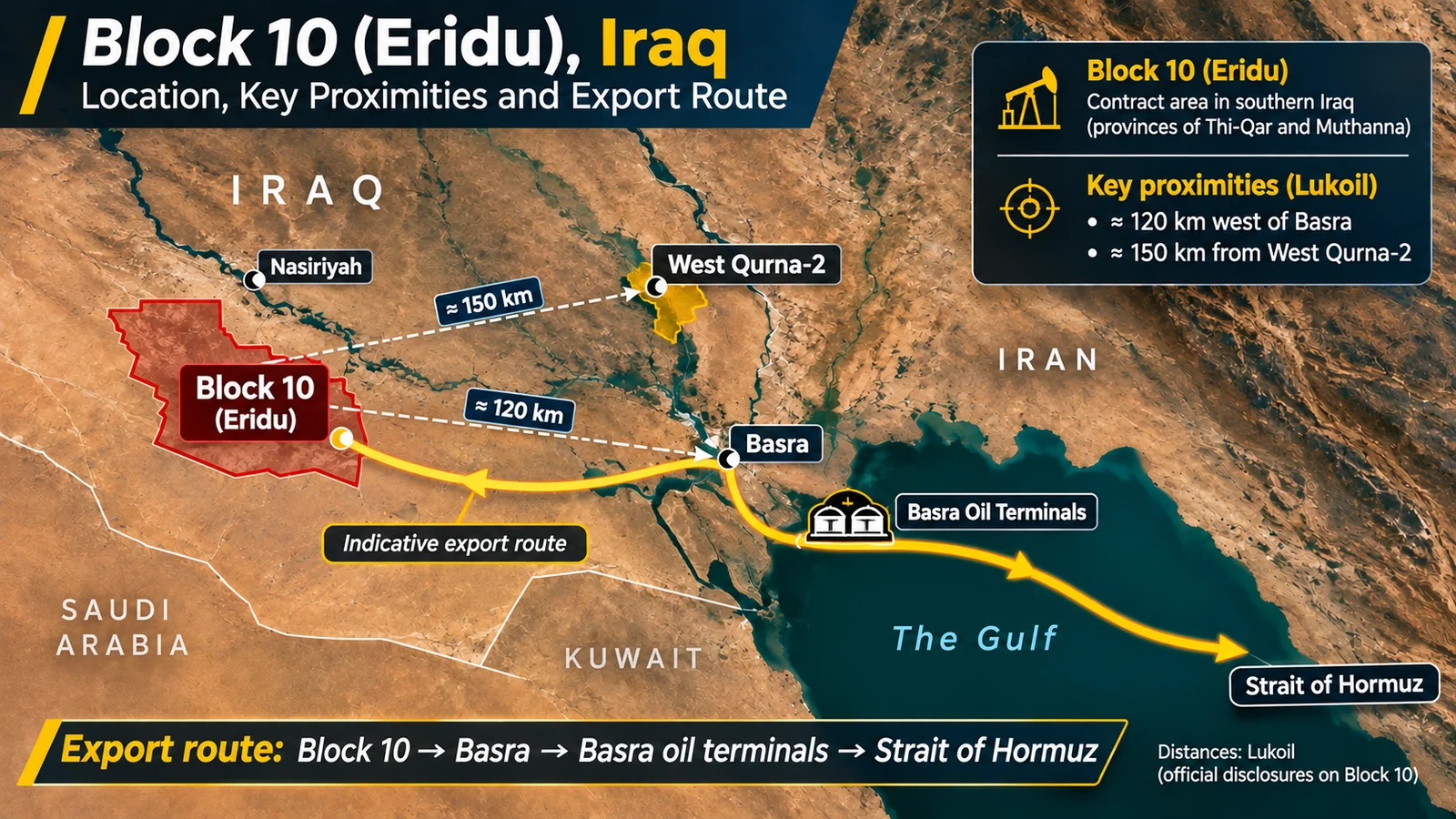
4. Commercial and export: open now. The Block 10 contract pays $5.99 per barrel, a fee set in the 2012 bid round, five years before anyone knew Eridu existed. Meanwhile, Iraqi exports fell from about 4.2 million b/d in February to about 1.45 million b/d in May when Hormuz closed, and Chevron is now evaluating the Kirkuk-Baniyas pipeline to the Mediterranean. Eridu sits 120 km west of Basra, with every barrel pointing south.
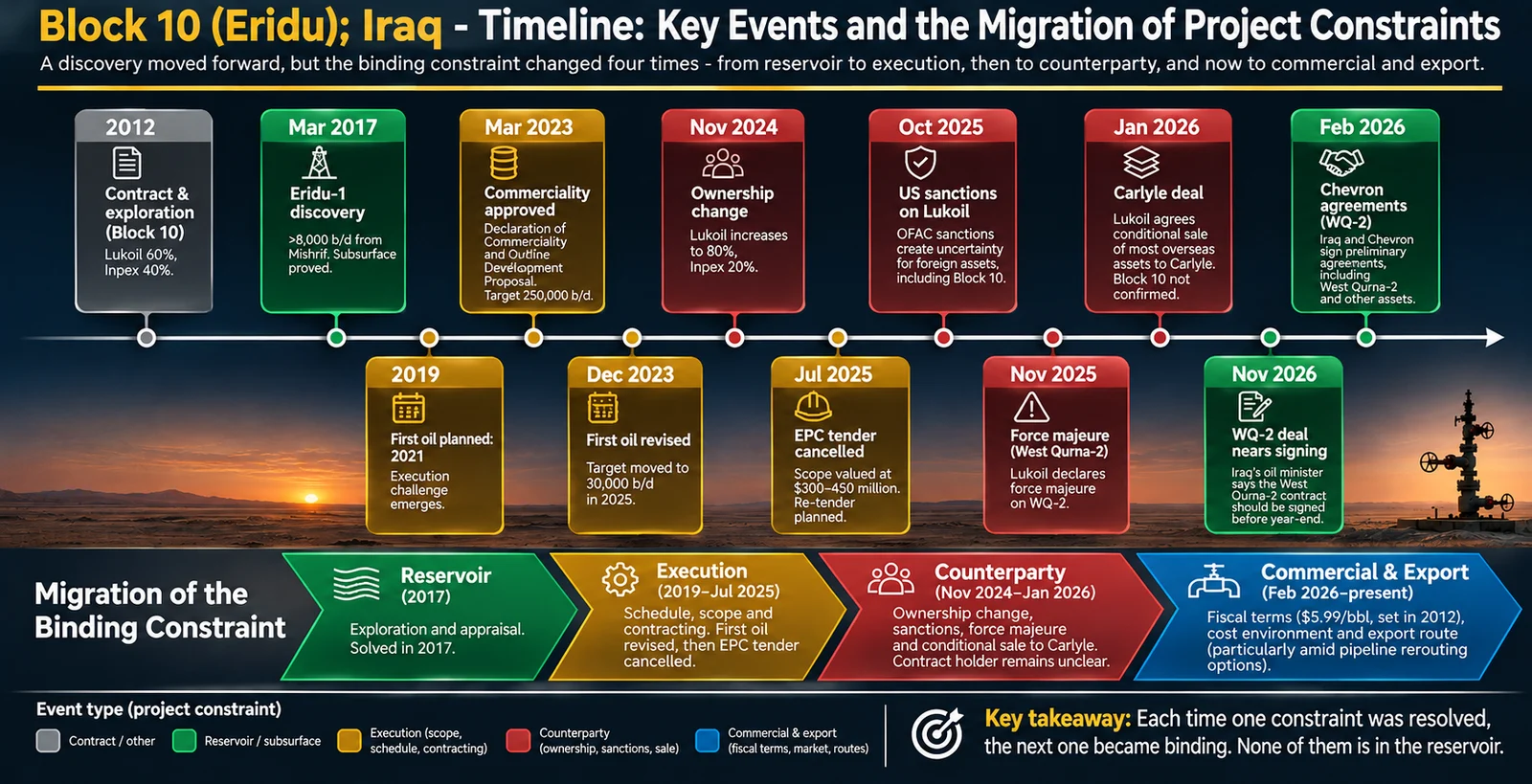
Each time one constraint was resolved, the next one became binding. None of them is in the reservoir.
A FEED does not travel with the asset
Whatever engineering exists for Eridu was built on a basis: a specific operator, fee, schedule, export outlet and cost environment. Most of those inputs have changed since 2023.
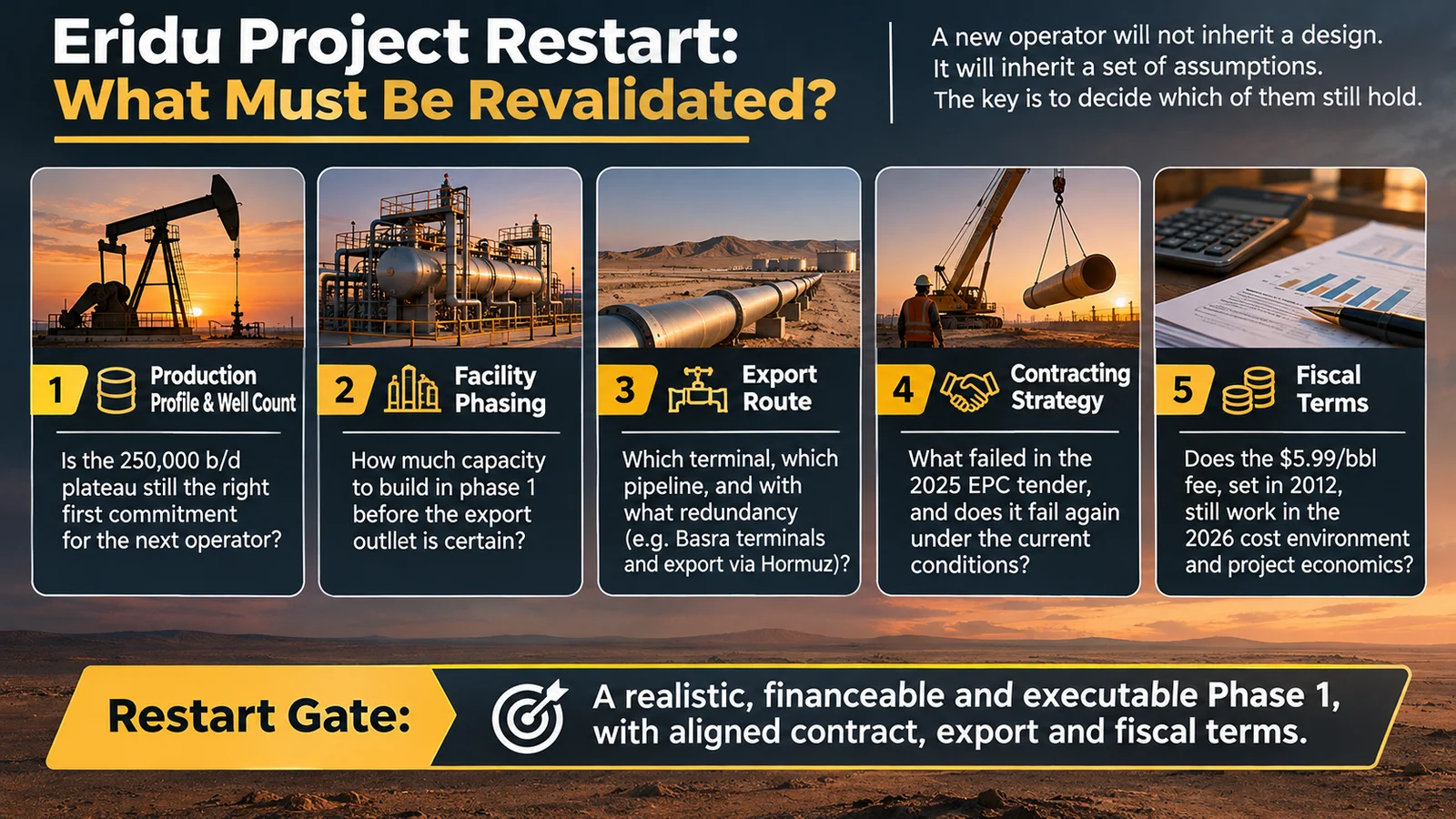
A FEED is a perishable asset. A new operator does not inherit a design. It inherits a set of assumptions, and it has to decide which ones still hold:
- Production profile and well count. Is the 250,000 b/d plateau still the right first commitment?
- Facility phasing. How much capacity to build before the export outlet is certain?
- Export route. Which terminal, which pipeline, what redundancy?
- Contracting strategy. Why was the 2025 tender cancelled, and does that risk remain?
- Fiscal terms against the cost base. Does a 2012 fee carry a 2026 cost environment?
There are two ways to get this wrong. Reuse the old basis unchecked, and the project carries stale assumptions into EPC. Discard it entirely, and years of appraisal and engineering are lost. The real work is sorting which decisions survive the change of owner.
Delay re-sizes projects
I have seen this mechanism from the inside. On a mature oil-rim field in southern Russia, I led the surface facilities workstream of an integrated development concept. It included a low-pressure gas compression station planned at around 500 million m3/yr for 2014.
The project competed for capital in the portfolio. It was commissioned in December 2020 at 300 million m3/yr. The engineering was not wrong. The gas profile moved while the project waited, and the facility was re-sized to the gas that was actually left.
At Eridu the reservoir is untouched, so the risk runs the other way. The reservoir has not moved, but the contract, the fee, the export route and the market have. A plateau designed against the 2023 basis is not automatically the right one for the next owner to commit to.
What would make Eridu investable
If I were sequencing this:
- Settle the contract holder. The West Qurna-2 route through a state company is now a working precedent.
- Re-base fiscal terms before re-basing the cost estimate, not after.
- Size phase 1 to the export outlet that is certain, not to the resource.
- Revalidate the FEED for phase 1 only, and re-tender on that scope.
- Take the full-field decision on phase 1 data, not on the 2023 proposal.
My estimate: even if the holder is settled in 2027, first oil is unlikely before around 2030 (±1 year). The build-up is in the calculation note below.
The pattern
Discovery value is quoted in barrels. Transaction value is quoted in certainty.
In sanctioned-asset transfers, buyers take producing assets first, at a negotiated premium for certainty. Discoveries come later, at a different price and on different terms. Iraq's target of 6 million b/d by 2029 will be delivered by fields that already flow. Eridu sits outside that window.
None of this makes Eridu a bad asset. It makes it an unpriced one. The next operator will not be paid for confirming the reservoir. It will be paid for converting a 2023 development basis into an executable, financeable programme.
Calculation note
Plateau fee pool. 250,000 b/d × 365 = ~91 million bbl/yr × $5.99 ≈ $550 million/yr gross remuneration to the contractor group, before fee adjustments and state partner terms; cost recovery is separate. Each $1/bbl change in the fee is worth about $90 million/yr at plateau.
Phase 1 alone. 30,000 b/d ≈ 11 million bbl/yr ≈ $65 million/yr in fees. Too small on its own to justify entry into a sanctioned-seller transaction.
Schedule build-up (author's estimate, ±25%). Terms and approvals 12-18 months + FEED revalidation and tender 6-12 months + early-production EPC 24-30 months = 42-60 months from contract settlement.
If you were Eridu's next operator, which decision from the 2023 basis would you keep, and which would you reopen first?
Working on a concept, Pre-FEED or a tender pack? A short call is often enough to see where the gaps are.